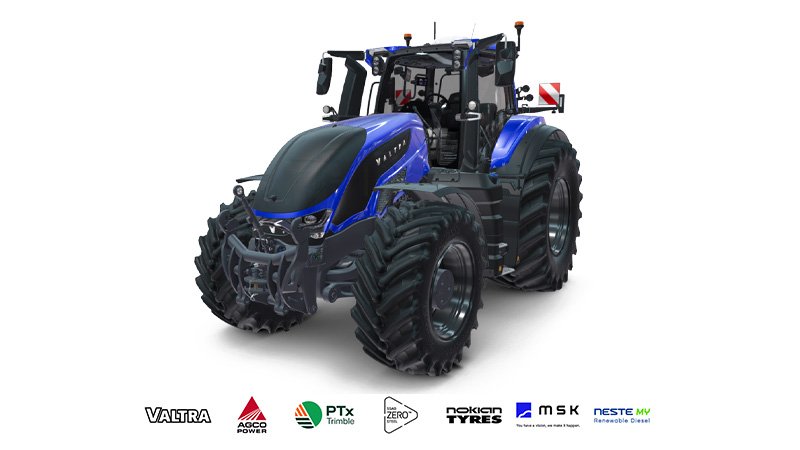

Probably the most sustainable tractor in the world
Valtra unveils vision for probably the World's most sustainable tractor at Agritechnica 2025
At Agritechnica 2025, Valtra proudly presented its bold vision for what is probably the most sustainable tractor in the world: the 6th generation S Series special concept.
Since its launch in 2023, the S Series has garnered international acclaim, winning all three major design awards in a single year, including the prestigious Red Dot Best of the Best Award – a feat no tractor has achieved before.
Built for sustainability from the ground up
The S Series is 100% built in Valtra’s Suolahti factory, which is fast approaching zero emissions status, having reduced emissions by 97% over five years. 100% of the electricity used at the factory comes from renewable sources. Approximately 50% of the components used at their Suolahti factory are sourced within Finland.
The S Series’ AGCO Power 84 LXTN engine is manufactured just 200 km from Valtra’s Suolahti factory. This engine is fully compatible with HVO (Hydrotreated Vegetable Oil), offering up to 90%* reduction in greenhouse gas emissions compared to fossil diesel.
All first fills at the Suolahti factory use Neste MY Renewable Diesel™ - a fuel made from 100% renewable raw materials which reduces greenhouse gas emissions up to 90%* when emissions over the fuel’s life cycle are compared to fossil diesel. Since 2017, Valtra has used over 5 million litres of this fuel, preventing more than 15,000 tons of greenhouse gases from entering the atmosphere.
Smarter materials, smarter farming
The S Series cabin, developed in collaboration with Finnish partners MSK Group, features materials and processes that reduce CO₂ emissions from manufacturing. By using cold-formed steel sheets produced with innovative methods, MSK reduces raw material CO₂ emissions by 68%. Advanced materials also cut emissions from drawn metal parts by 40%, while alternative profile tube materials can further lower emissions by up to 69%. Special reflective glass in the cabin reduces air-conditioning energy consumption, contributing to lower fuel usage.
The S Series showcased at Agritechnica featured Nokian Tyres’ Soil King VF tyres, incorporating Intuitu™ 2.0 smart technology - the industry's first commercially available smart tyre technology with load-sensing, delivering easy, fast and precise pressure recommendations. The tyres offer 6 % more treated area per working hour, 8 % lower fuel consumption in cultivation work, and 5 % lower fuel consumption in transport work. The S Series at Agritechnica is also fitted with Valtra’s Central Tyre Inflation System (CTIS), which, according to research by Valtra and AGCO’s Agronomy Team, enables precise pressure adjustments, reducing soil compaction by 17% and field fuel consumption by 7%.
The concept tractor also showcases an innovation in wheel manufacturing which is currently in development. The hub of the wheel by Nokian Tyres is made with SSAB Zero™ – based on recycled steel and fossil-free energy with up to 75% lower carbon emissions than traditional steel.
Data-driven sustainability
Also showcased on the concept Valtra S Series was the AGCO Power CO₂ Calculator concept – a pioneering solution currently in development that uses fuel sensors and cloud-based software to detect fuel types, calculate emissions, and generate authenticated sustainability reports. This empowers farmers to make informed decisions and demonstrate their environmental impact with precision.
The S Series integrates Valtra’s smart farming technologies powered by PTx Trimble, including Valtra Guide, Auto U-Pilot, SmartTurn, and Valtra Connect. These tools automate field operations, reduce input use, and support data-driven decision-making for more sustainable and productive farming.
The AGCO Power CO2 Calculator and wheel hub by Nokian Tyres are presented as concepts. No exact release dates are disclosed at launch.
Visit Valtra at Agritechnica, Hall 20, Stand A40, Hanover, 9–15 November 2025.
*In Europe calculation method EU RED III (revised RED EU/2018/2001). The GHG emission reduction varies depending on the region-specific legislation that provides the methodology for the calculations, as well as the raw material mix used to manufacture the product for each market.